


High-Voltage Rectifier Diodes in Power Supplies, Inverters, Industrial Control, and Home Appliances
Rectifier diodes are among the most widely used components in power electronics. Although they are often considered “basic parts,” their selection directly affects efficiency, thermal performance, EMI behavior, and long-term reliability. In applications such as AC/DC power supplies, inverters, industrial control systems, and home appliances, rectifier diodes must withstand repetitive reverse voltage stress, handle surge current at startup, and remain stable under elevated temperature conditions.
1.Why DO-41 Rectifiers Are Still Popular
The DO-41 axial package remains a mainstream solution due to its balanced performance and manufacturing convenience. Compared with smaller signal diode packages, DO-41 provides improved mechanical strength, higher power dissipation capability, and stable soldering performance for through-hole assembly. The cathode band marking also simplifies polarity identification and reduces assembly errors.
For many cost-sensitive and high-reliability products, DO-41 rectifiers continue to be a preferred choice for:
AC to DC rectification
Freewheeling and commutation paths
Reverse polarity protection
General power switching functions
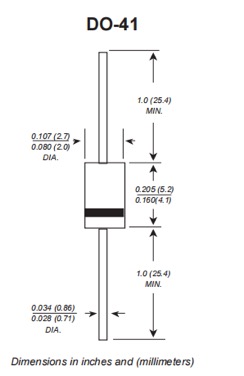
2. Typical Applications
2.1 AC/DC Power Supplies
In offline power supplies, rectifier diodes are often used in:
Input bridge or half-wave rectification
Auxiliary power circuits
Secondary-side rectification (low-frequency rails)
The key requirements include stable reverse voltage margin, predictable thermal behavior, and surge capability during capacitor charging.
2.2 Inverters and Motor Drives
In inverters and motor drive systems, rectifiers may appear in:
Control power supplies
Snubber or clamp networks
Protection circuits
These systems often operate under high electrical noise, high temperature, and switching transients. Choosing a diode with strong reverse withstand capability helps reduce unexpected breakdown risk.
2.3 Industrial Control and Automation
Industrial control boards often require long-term stability in harsh environments. Rectifier diodes used in input power, relay driving, or protection circuits must maintain performance under continuous operation and temperature cycling.
2.4 Home Appliances
Appliances such as air conditioners, washing machines, induction cookers, and microwave ovens contain multiple rectification and protection stages. In these designs, reliability and production consistency are essential, especially for high-volume manufacturing.
3. Reverse Voltage Rating: The First Critical Parameter
The reverse voltage rating is a fundamental factor when selecting rectifier diodes. In real systems, the reverse voltage across a diode is not always equal to the nominal mains voltage. It can be significantly higher due to:
Line surges
Inductive load switching
Transformer leakage inductance ringing
Fast recovery behavior of surrounding devices
For this reason, engineers typically select rectifier diodes with adequate voltage margin above the expected peak reverse voltage. The TOPDIODE EM513–EM518 series offers high-voltage options within the same DO-41 family, supporting a wide range of design needs up to the 2kV level.
A conservative voltage selection improves field reliability, especially for industrial and inverter systems exposed to frequent electrical transients.
4. Forward Current vs. Real Thermal Limits
Many designers focus on rated average forward current, but the real limitation often comes from thermal conditions. Junction temperature depends on:
Conduction loss (IF × VF)
Ambient temperature
PCB and lead heat dissipation
Airflow and enclosure design
In compact power supplies and appliance control boards, airflow may be limited. Even if the diode current is below its nominal rating, poor thermal dissipation can cause excessive junction temperature rise.
The derating curve provides a useful reference for estimating allowable current at higher ambient temperatures and helps prevent overheating during long-term operation.
5. Surge Current Capability: A Hidden Reliability Factor
Surge current is often overlooked, yet it is one of the most common causes of rectifier diode stress. Typical surge events include:
First power-on charging of bulk capacitors
Transformer magnetizing inrush
Short transient overload conditions
Repetitive power cycling
A diode with strong surge capability provides additional safety margin against occasional high-current pulses. This becomes particularly important in industrial power supplies and appliances that may be frequently switched on and off.
6. Forward Voltage Drop: Efficiency and Heat Generation
Forward voltage drop is directly related to conduction loss and heat generation. In low-frequency rectification, silicon rectifiers typically show a forward drop around 1V at rated current. While this is acceptable in many applications, designers should evaluate:
Expected operating current range
Thermal rise in the enclosure
Efficiency targets
For low-voltage, high-current rails, Schottky rectifiers may reduce conduction loss. However, in higher-voltage applications, standard silicon rectifiers remain advantageous due to their strong reverse withstand capability and stable operating behavior.
7. Reverse Leakage: Especially Important at High Temperature
Reverse leakage current increases as temperature rises. In industrial control systems, power cabinets, and inverter environments, ambient temperature may be significantly higher than standard room conditions. Excessive leakage can lead to:
Additional power loss
Increased heat generation
Unexpected behavior in sensitive circuits
Selecting a diode series with stable leakage performance and providing sufficient thermal margin helps ensure consistent operation over the product lifetime.
8. Junction Capacitance and Switching Behavior
Although general purpose rectifiers are not optimized for ultra-fast switching, junction capacitance still plays a role in EMI behavior and transient response. In some power circuits, diode capacitance can influence:
Switching noise coupling
Transient voltage overshoot
Ringing behavior
Understanding capacitance trends helps designers improve EMI robustness, especially in inverter-related circuits.
9. Practical Selection Checklist (Engineer-Friendly)
When choosing a DO-41 rectifier for power supplies, inverters, industrial control, or home appliances, consider the following checklist:
Reverse voltage margin
Choose sufficient VRRM margin for surges and transients.
Average current vs thermal design
Verify current derating based on real ambient temperature and airflow.
Surge current capability
Ensure the diode can survive inrush and capacitor charging pulses.
Forward voltage and power loss
Estimate conduction loss and confirm safe junction temperature.
Leakage at high temperature
Confirm stability under hot operating conditions.
Mechanical and assembly reliability
Ensure stable soldering performance for mass production.
In modern power electronics, rectifier diodes continue to play a vital role in reliability and performance. For designs in AC/DC power supplies, inverters, industrial control systems, and home appliances, selecting a robust DO-41 rectifier with sufficient voltage margin, strong surge capability, and predictable thermal behavior is essential.
TOPDIODE EM513–EM518 DO-41 general purpose rectifiers offer a practical solution for high-voltage rectification and protection needs across a wide range of applications. For faster part selection, cross-reference support, and sample requests, please contact TOPDIODE sales for technical assistance.
Pingback: finasteride brand
Pingback: diflucan generic
Pingback: linezolid antibiotic for uti
Pingback: antibiotics for uti
Pingback: furosemide 40 mg tablet generic
Pingback: cialis markings
Pingback: xenical generic brand
Pingback: sildenafil 20 mg cost
Pingback: avanafil generic price
Pingback: semaglutide prezzo online
Pingback: shallow breathing ozempic
Pingback: can flagyl cause black urine
Pingback: metronidazole gel reddit
Pingback: canada generic cialis
Pingback: minoxidil foligain review
Pingback: terbinafine mechanism scientific explanation
Pingback: ivermectin oral pharmacokinetics
Pingback: minoxidil detailed faq
Pingback: minoxidil foam vs liquid tolerability
Pingback: vardenafil safety and tolerability