

How to Select the Right DC-DC Buck Converter IC for Industrial & IoT Applications
Why DC-DC Converters in Your Embedded Design?
A buck converter IC integrates the control circuitry required to efficiently reduce the voltage from a higher input level to a regulated lower output. Compared with linear regulators, buck converters offer significantly higher efficiency, especially when the input voltage is much higher than the required output voltage. This makes them ideal for industrial electronics, IoT devices, battery-powered systems, and embedded platforms where power efficiency and heat dissipation are critical considerations.
However, selecting the right converter is not always straightforward. Engineers must evaluate multiple buck converter IC features, including input voltage range, output current capability, switching frequency, efficiency, protection mechanisms, and thermal performance. This article will cover the comprehensive guide on how to select the right DC-DC converter for your design application.
What Is a DC-DC Buck Converter?
A DC-DC buck converter is a type of switching power supply designed to efficiently step down a higher DC voltage to a lower DC voltage. It is one of the most widely used power conversion solutions in modern electronics, particularly in industrial systems, embedded devices, and IoT applications where efficient power management is essential.
Buck converter consists of several key components:
Key components of a DC-DC converters
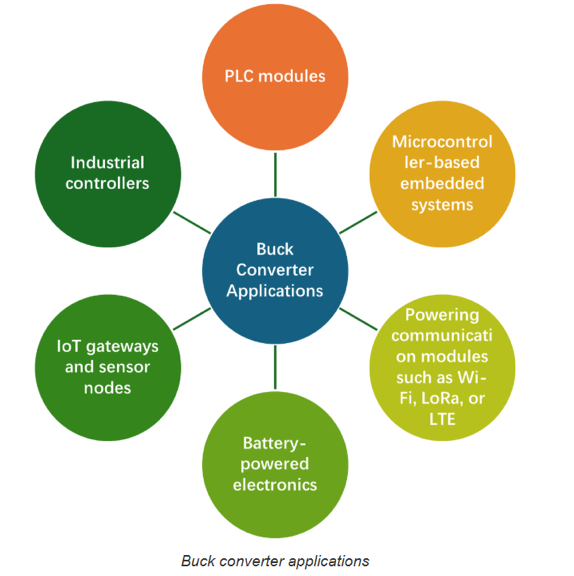
In practical designs, buck converter ICs integrate many of the control functions required for efficient voltage regulation. Modern ICs may include features such as Adjustable output voltage, and overcurrent and thermal protection. Therefore, selecting the right buck converter IC is often a crucial step in DC-DC power supply design. Buck converters are commonly used in applications such as:
Types of DC-DC Converters
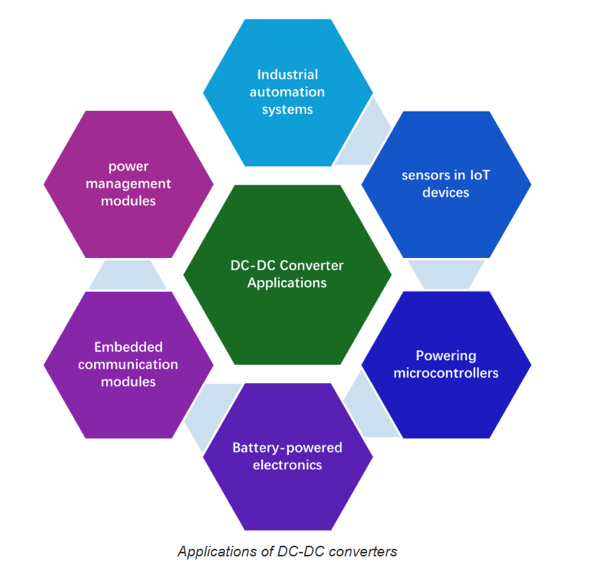
DC-DC converters are essential building blocks in modern electronic systems because they allow designers to efficiently convert one DC voltage level to another. Depending on the application requirements—such as voltage level, efficiency, power consumption, or system architecture—different types of DC-DC converters can be used. Understanding these converter types helps engineers make better decisions during the DC-DC buck converter IC selection process.
DC-DC converters are broadly categorized into following types:
Buck Converter (Step-Down Converter)
A buck converter is designed to reduce a higher input voltage to a lower output voltage. It is the most commonly used DC-DC converter in embedded electronics because many systems require low-voltage rails such as 5V, 3.3V, or 1.8V derived from higher supply voltages like 12V or 24V.