

Topdiode TPA06P5K4L: A High-Efficiency Replacement for onsemi NDS0605
channel MOSFETs play a crucial role in power control circuits thanks to their fast switching speed, low power loss, and compact size. Topdiode’s TPA06P5K4L is a P-channel enhancement-mode MOSFET designed for low-power switching applications. Packaged in the widely used SOT-23 footprint, it serves as an excellent drop-in replacement for the onsemi NDS0605 as well as other popular devices such as Fairchild NDS0610, Vishay Si2303DS, and NXP BSS84. With stable electrical performance and high reliability, the TPA06P5K4L is well suited for a broad range of modern electronic applications.

Device Structure and Pin Functions
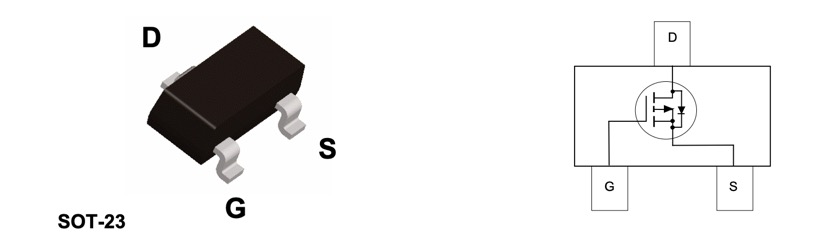
The TPA06P5K4L uses a standard SOT-23 package with three pins:
Pin 1: G (Gate)
The control pin that determines the MOSFET’s on/off state. As a P-channel MOSFET, it requires a negative gate-to-source voltage to turn on.
Pin 2: D (Drain)
The output pin where current flows out, typically connected to the load.
Pin 3: S (Source)
The input current pin, usually connected to the power supply or reference voltage.
The compact SOT-23 package allows efficient PCB layout and is ideal for small, space-constrained designs.
Key Application Areas
Power Management Systems
The TPA06P5K4L is commonly used in DC-DC converters, load switches, and power management circuits. Its low RDS(on) reduces power loss and heat generation, improving the stability and efficiency of the power system.
Portable and Battery-Powered Devices
Devices such as smartwatches, wireless earbuds, power banks, and smartphones benefit greatly from this MOSFET. Its small size saves PCB space, while its low power consumption helps extend battery life.
Industrial Control
In automated control systems, the TPA06P5K4L can drive small motors, relays, LEDs, and other light-load components. Its fast switching speed provides quick signal response, improving system accuracy and reliability.
New Energy Systems & IoT Devices
For low-power sensor nodes, smart home modules, and battery-driven IoT devices, the TPA06P5K4L offers efficient switching performance. Its low power loss and high efficiency meet the requirements of modern low-power electronic designs.
Replacement Guide: Comparing with onsemi NDS0605
When using the TPA06P5K4L as a replacement for the onsemi NDS0605, the following parameters should be examined:
Voltage & Current Ratings
The TPA06P5K4L is rated at
VDS = –60 V
ID = –0.18 A
The TPA06P5K4L provides full compatibility with these ratings, making it suitable for the same low-power switching applications.
Power Dissipation & Thermal Considerations
Both devices use the SOT-23 package, whose thermal performance is inherently limited. Designers should calculate the MOSFET’s actual power dissipation and ensure it does not exceed the device’s maximum power rating. Increasing copper area around the drain pad can significantly improve heat dissipation.
Gate Drive Requirements
As P-channel MOSFETs, both devices require a negative VGS to achieve low on-resistance. Ensure the driving circuitry—such as a microcontroller or dedicated driver IC—can provide adequate negative voltage for proper conduction.
Package Compatibility
The TPA06P5K4L shares the same footprint and pad layout as the NDS0605, enabling direct drop-in replacement without modifying the PCB layout.
Testing Methods (FAQ)
Q1: How to quickly test whether the MOSFET is functional?
Diode-mode test:
Red probe on Source, black probe on Drain
A diode drop of 0.5–0.7 V should appear
Reverse measurement should show open circuit
Switching test:
Measure resistance between Drain and Source
Apply a negative voltage or discharge/charge the Gate
Resistance should switch between high (off) and low (on)
Q2: What voltage and current ranges is the TPA06P5K4L suitable for?
It works well in common DC systems such as 12 V, 24 V, and 48 V, and is ideal for signal switching, small load driving, and logic-level conversion. It is not recommended for high-power loads.
Common Issues & Recommended Solutions
Issue 1: Device overheating
Cause: Excessive current or high switching frequency leading to increased dynamic losses.
Solution: Ensure current does not exceed the –0.18 A limit
Increase PCB copper area for heat spreading
Consider MOSFETs with lower RDS(on) for higher-power applications
Issue 2: MOSFET does not fully turn on/off
Cause: Insufficient or incorrect gate drive voltage.
Solution:
Ensure the driver provides adequate negative VGS
Avoid situations where gate voltage stays near 0 V or becomes positive
Issue 3: Device failure
Cause: ESD events, voltage spikes, or overcurrent.
Solution: Implement proper ESD handling
Add protective components (e.g., Zener diodes, snubbers)
Ensure voltage/current stays within absolute maximum ratings