

Common Cathode vs Common Anode Fast Recovery Diodes: What’s the Difference?
In modern power electronics, Fast Recovery Diodes (FRDs) are widely used in high-frequency switching circuits due to their short reverse recovery time and high efficiency. Engineers often encounter two common configurations in dual-diode packages: Common Cathode and Common Anode structures.
Understanding the difference between these two types is important when designing or selecting rectification and freewheeling circuits for power supplies, inverters, motor drives, and industrial equipment.
What Is a Fast Recovery Diode?
A Fast Recovery Diode is a semiconductor device designed with a very short reverse recovery time (trr). Compared with standard rectifier diodes, FRDs reduce switching losses and improve efficiency in high-frequency applications.
Typical features include:
- Fast switching speed
- Low reverse recovery loss
- High efficiency
- High voltage capability
- Stable thermal performance
- FRDs are commonly used in:
- SMPS (Switching Mode Power Supplies)
- Inverters
- Industrial welding equipment
- UPS systems
- Motor drives
- LED power systems
Common Cathode Fast Recovery Diodes
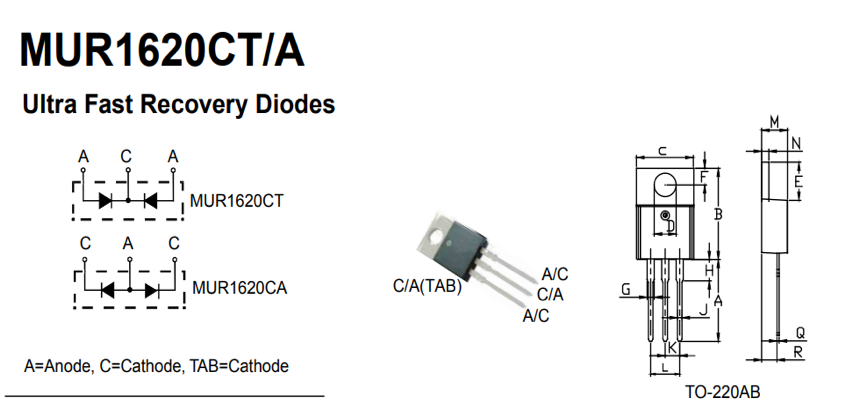
A Common Cathode diode contains two diode chips internally connected through a shared cathode terminal.
Structure
Two anodes
One shared cathode
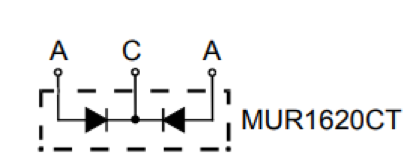
Typical Symbol
Simplifies PCB routing
Reduces component count
Suitable for center-tapped rectification
Compact package design
Common Applications
Output rectification circuits
High-frequency switching power supplies
DC-DC converters
Secondary-side rectifiers
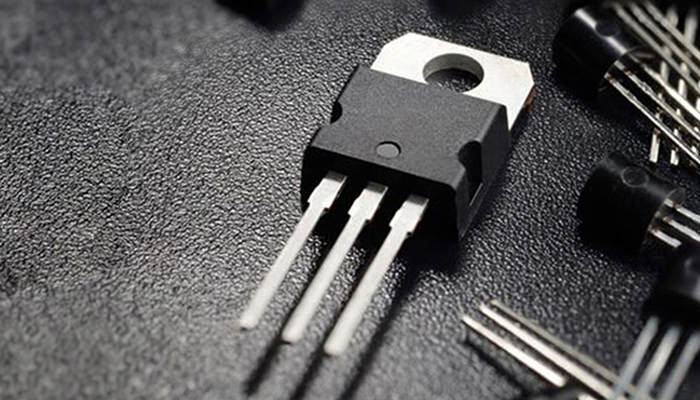
Common cathode FRDs are frequently used in TO-220AB, TO-247, and TO-252 packages for power applications.
Common Anode Fast Recovery Diodes
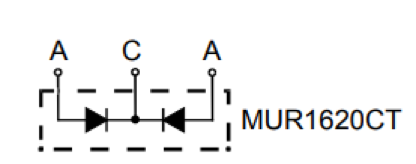
A Common Anode diode integrates two diode chips sharing the same anode terminal.
Structure
Two cathodes
One shared anode
Typical Symbol
Advantages
Convenient for specific inverter topologies
Optimized layout for negative rail designs
Reduces wiring complexity
Common Applications
Inverter circuits
Freewheeling circuits
Motor control systems
Half-bridge and full-bridge power designs
How to Choose Between Common Cathode and Common Anode FRDs
When selecting an FRD configuration, engineers usually evaluate the circuit topology first.
| Parameter | Common Cathode | Common Anode |
| Shared Terminal | Cathode | Anode |
| Typical Use | Rectification | Freewheeling / Inverter |
| PCB Layout | Easier positive-side routing | Easier negative-side routing |
| Common Application | SMPS output stage | Motor drives & inverter stage |
Other important selection factors include:
Reverse voltage (VRRM)
Forward current (IF)
Reverse recovery time (trr)
Thermal resistance
Package type
Surge capability
Why Fast Recovery Matters
In high-frequency switching circuits, slow reverse recovery can cause:
Increased switching loss
Excess heat generation
EMI issues
Reduced system efficiency
Fast Recovery Diodes help minimize these problems, making them essential in modern power electronics.
Fast Recovery Diode Solutions from Topdiodes MUR1620CT/A
Key Benefits:
- Stable and reliable performance
- High-speed recovery characteristics
- Competitive replacement solutions
- RoHS compliant
- Short lead time support
Whether you are developing a new design or searching for alternative semiconductor solutions, Topdiodes can provide reliable FRD products with engineering support.