

The “Ears and Voice” of AI: How Audio ICs Define Clarity in 2026 Humanoid Robots
As Artificial Intelligence transitions from cloud-based chatbots to physical Humanoid Robots, the interface of interaction is shifting back to the most natural human form: Speech.
In the noisy, unpredictable environments of 2026—from bustling smart factories to chaotic households—the hardware responsible for sound processing, the Audio IC, has become the critical factor in determining whether a robot feels like an intelligent companion or a malfunctioning machine.
The Challenge: Why “Hearing” is Hard for Robots
Unlike a smartphone held close to the mouth, a robot must deal with Far-Field Voice Capture. It faces internal mechanical noise (motors and fans) and external ambient echoes.
- Smart Amplifiers (Class-D): Modern Audio ICs must drive powerful yet compact speakers to provide clear, human-like feedback without distorting, even at high volumes.
- High-SNR ADCs: To “hear” a whisper across a room, the Analog-to-Digital Converters (ADCs) within the Audio IC must have an extremely high Signal-to-Noise Ratio (SNR) to distinguish voice from background hum.
Key Components in the Audio Signal Chain
A. Digital Signal Processors (DSP) with Edge AI
In 2026, Audio ICs are no longer “dumb” converters. Integrated DSPs now perform AEC (Acoustic Echo Cancellation) and ANS (Automatic Noise Suppression) locally. This reduces the latency of voice recognition, allowing the robot to respond in sub-100ms, making conversations feel fluid.
B. Audio Codecs with Low Power Consumption
For battery-operated robots, every milliwatt counts. High-efficiency Codecs ensure that the “always-on” voice trigger doesn’t drain the robot’s main battery, allowing it to stay alert for days in standby mode.
C. Protection: The Unsung Heroes (TVS & Varistors)
Because robots are packed with high-power motors (controlled by Driver ICs), they generate significant electromagnetic interference (EMI).
- TVS Diodes: Protect the sensitive Audio IC pins from electrostatic discharge (ESD) during human-robot touch.
- Varistors: Safeguard the audio power rails from voltage spikes caused by sudden motor stops.
2026 Market Trend: High-Resolution Audio for Empathy
As robots enter the healthcare and hospitality sectors, the Audio IC must support Hi-Res Audio. Why? Because subtle inflections in a robot’s voice—driven by high-quality DACs (Digital-to-Analog Converters)—are essential for conveying empathy and building trust with elderly patients or hotel guests.
Sourcing Reference: Key Players to Watch
If you are a sourcing manager or an engineer looking for the best Audio IC solutions in 2026, these are the industry benchmarks:
- Texas Instruments (TI): Look for their TAS series (Smart Amplifiers) which are the gold standard for robust industrial audio.
- Analog Devices (ADI): Their SigmaDSP technology offers the most flexible sound tuning for complex robotic environments.
- Cirrus Logic: Leading the way in low-power, high-fidelity Codecs for mobile and humanoid platforms.
- Realtek / Everest: High-efficiency, cost-effective solutions for mass-market consumer robots.
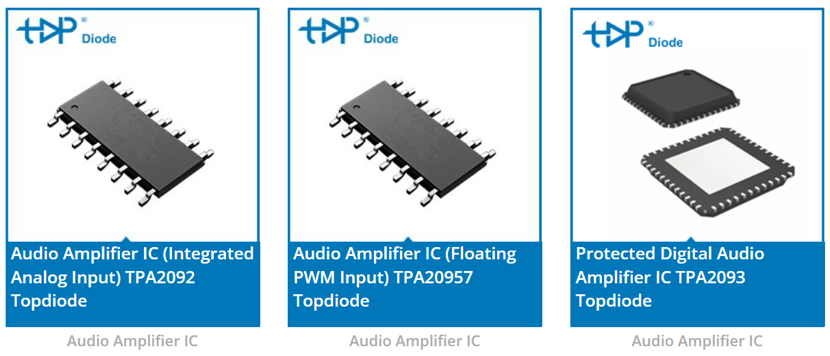
Topdiode Audio IC
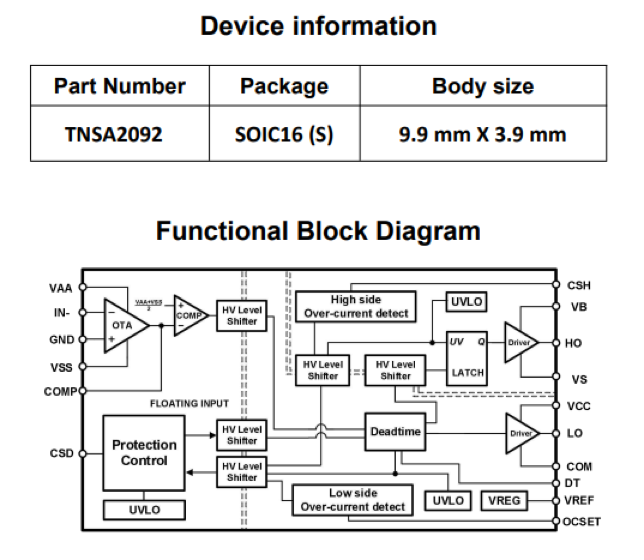
Topdiode TPA2092 is an equivalence of Infineon IRS2092, Topdiode TPA2093 is alternative of Infineon IRS2093, and Topdiode TPA20957 is alternative of Infineon IRS20957S.