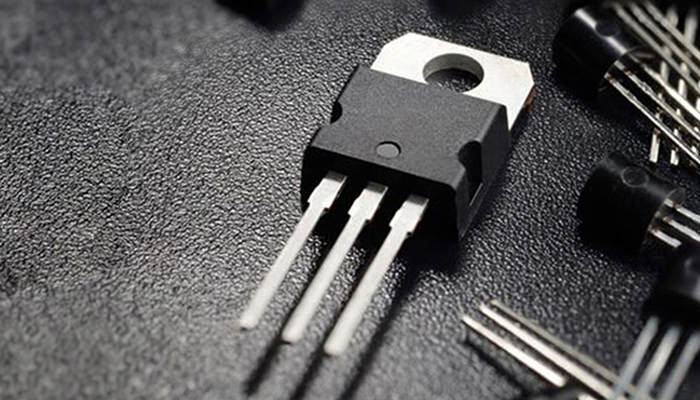


Topdiode T12 12A TRIAC: A Reliable Alternative to ST BTA12, BTB12 and T12xx TRIACs
TRIACs are widely used in AC power switching and phase-control circuits because they can conduct current in both directions. They are commonly found in light dimmers, heater controllers, motor speed regulators, household appliances and industrial AC control systems.
The Topdiode T12 12A TRIAC series provides voltage options of 600V, 800V and 1200V, an RMS on-state current rating of 12A, and multiple gate-trigger current options. It is designed for applications where engineers are evaluating alternatives to the ST BTA12, BTB12 and T12xx TRIAC series.
Depending on the required package, voltage rating, gate sensitivity and thermal performance, Topdiode T12 devices can be considered for use in general-purpose AC switching, heating control, motor control and phase-control applications.
What Is a TRIAC?
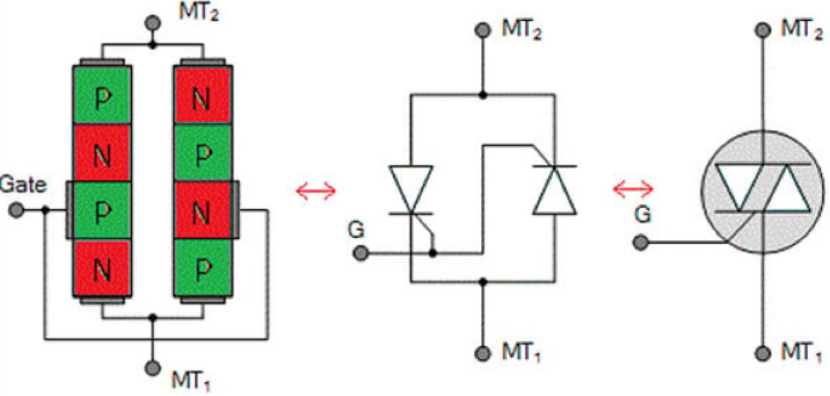
A TRIAC, or Triode for Alternating Current, is a three-terminal semiconductor device used to control alternating current.
Its three terminals are:
- Main Terminal 1, or MT1
- Main Terminal 2, or MT2
- Gate, or G
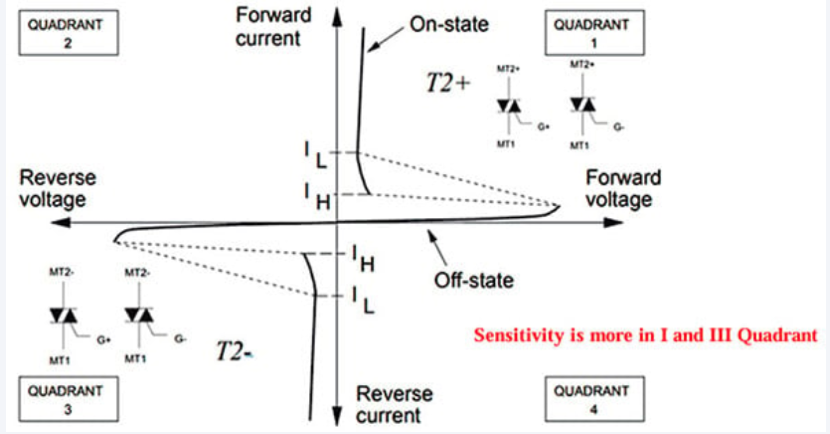
Unlike a standard Silicon-Controlled Rectifier, which mainly conducts current in one direction, a TRIAC can conduct during both the positive and negative half-cycles of an AC waveform.
This bidirectional switching capability allows a single TRIAC to control the power delivered to an AC load without requiring two separate switching devices.
How Does a TRIAC Work?
A TRIAC remains in its off state until a suitable electrical pulse is applied to the gate terminal.
When the gate receives a trigger signal, the TRIAC switches on and allows current to flow between MT1 and MT2. After triggering, the device normally remains conductive even when the gate signal is removed.
The TRIAC turns off when the current through the main terminals falls below its specified holding current. In an AC circuit, this usually happens naturally when the current crosses zero at the end of each half-cycle.
By adjusting the point at which the TRIAC is triggered during each AC cycle, a control circuit can regulate the average power supplied to the load. This operating method is commonly known as phase-angle control.
Common TRIAC Applications
Because TRIACs can control current in both directions, they are widely used in AC switching and power-control applications.
Typical applications include:
Light Dimmers
A TRIAC can adjust the brightness of incandescent lamps and compatible dimmable LED lighting by changing the trigger point during each AC half-cycle.
Motor Speed Controllers
TRIACs can regulate the power supplied to certain AC motors used in ceiling fans, power tools, blowers and household appliances.
Heating Control
Electric heaters, ovens, temperature-control systems and industrial heating equipment can use TRIACs to switch or regulate heating elements.
Solid-State AC Switching
TRIACs can function as semiconductor switching elements in static relays and other contactless AC switching circuits.
Household Appliances
TRIACs are commonly used in washing machines, vacuum cleaners, kitchen appliances, ventilation systems and other white goods.
Overview of ST BTA12, BTB12 and T12xx TRIACs
The ST BTA12, BTB12 and T12xx series are medium-current TRIACs used in general-purpose AC mains switching and phase-control applications.
They are commonly selected for:
- Static relays
- Heating regulation
- Induction motor starting circuits
- Light dimmers
- Appliance motor speed controllers
- General AC on/off switching
Depending on the specific part number, these TRIACs may be supplied in insulated or non-insulated through-hole and surface-mount packages.
Common characteristics associated with these product families include medium-current capability, low thermal resistance and high commutation performance.
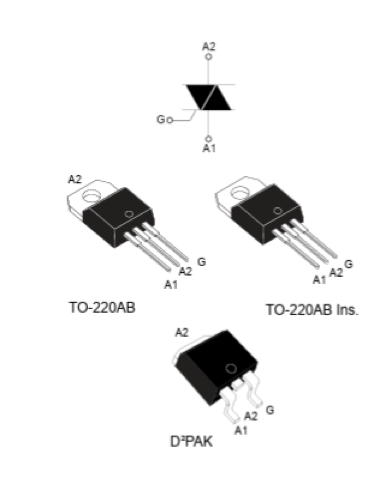
Topdiode T12 12A TRIAC Features
The Topdiode T12 series is developed for reliable AC power-control applications requiring a 12A TRIAC.
Its main features include:
- Glass-passivated junction construction
- 12A RMS on-state current rating
- 600V, 800V and 1200V voltage options
- High-voltage and surge-current capability
- Low thermal resistance
- Three-quadrant triggering
- Multiple gate-trigger sensitivity options
- Insulated and non-insulated package options
- Suitable for AC switching and phase-control circuits
Glass-passivated junction technology helps improve junction stability and supports reliable operation under high-voltage conditions.
The three-quadrant triggering design is suitable for applications requiring improved commutation performance and reduced sensitivity to electrical noise.
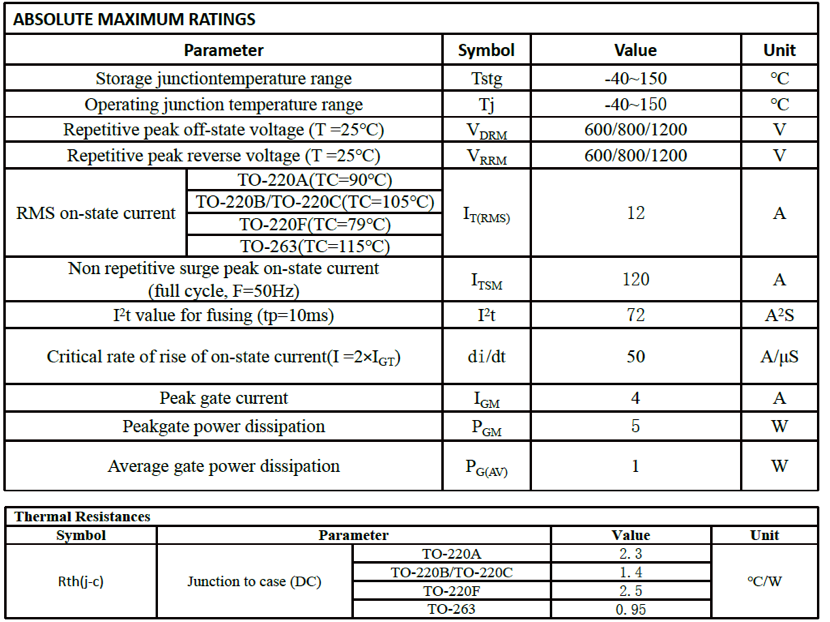
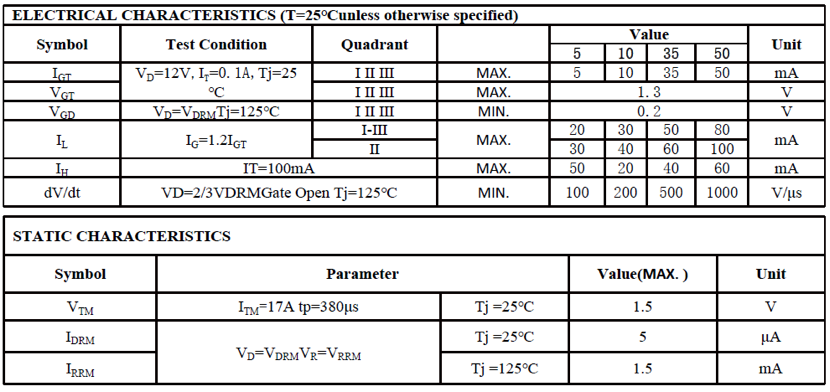
Topdiode T12 Key Specifications
| Parameter | Symbol | Topdiode T12 value |
|---|---|---|
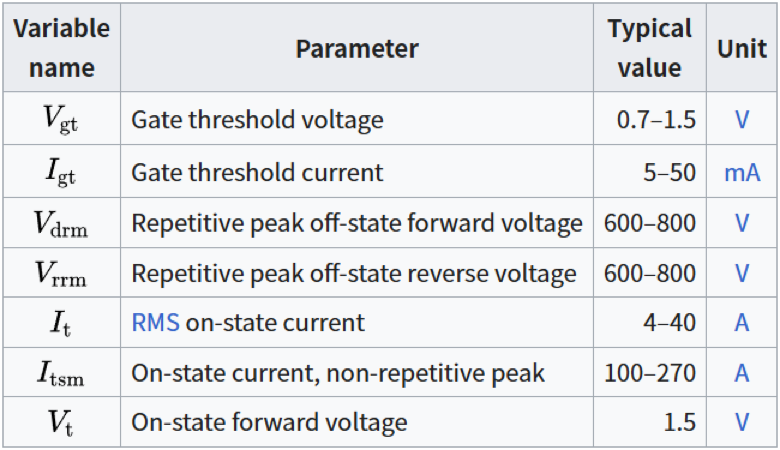
| Repetitive peak off-state voltage | VDRM | 600V / 800V / 1200V |
| Repetitive peak reverse voltage | VRRM | 600V / 800V / 1200V |
| RMS on-state current | IT(RMS) | 12A |
| Gate-trigger current options | IGT | 5mA / 10mA / 35mA / 50mA |
| Non-repetitive surge on-state current | ITSM | 120A |
| Maximum on-state voltage | VTM | 1.5V |
| Operating junction temperature | TJ | −40°C to +150°C |
| Storage junction temperature | TSTG | −40°C to +150°C |
| Critical rate of rise of on-state current | di/dt | 50A/μs |
The available electrical characteristics may vary according to the selected voltage class, gate-trigger current and package. Engineers should always verify the final device datasheet before approving a replacement.
Available Package Options
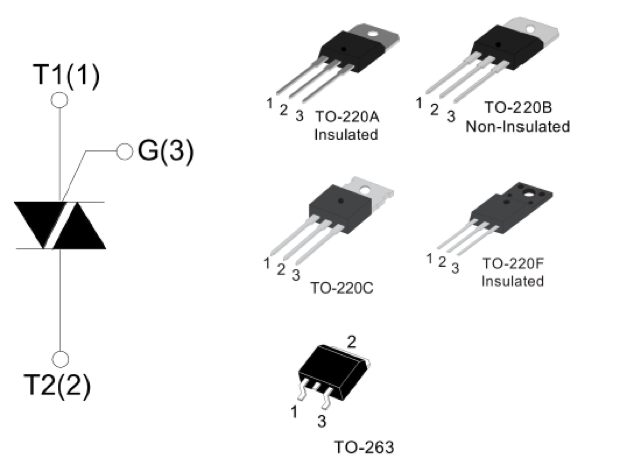
The Topdiode T12 TRIAC series is available in several package configurations, including:
- TO-220A insulated
- TO-220B non-insulated
- TO-220C
- TO-220F insulated
- TO-263 surface-mount package
Package selection affects mounting, electrical isolation, heat dissipation and PCB layout.
An insulated package can simplify heatsink installation where electrical isolation between the device tab and heatsink is required. A non-insulated package may provide different thermal characteristics but can require additional insulation materials.
Can Topdiode T12 Replace ST BTA12 or BTB12?
The Topdiode T12 series can be evaluated as an alternative to selected ST BTA12, BTB12 and T12xx devices when the essential electrical and mechanical specifications are compatible.
Before replacing an existing TRIAC, engineers should compare the following parameters:
- RMS on-state current, IT(RMS)
- Repetitive peak off-state voltage, VDRM
- Gate-trigger current, IGT
- Holding current, IH
- Latching current, IL
- Surge on-state current, ITSM
- On-state voltage, VTM
- Static and commutating dv/dt
- Package type and insulation
- Pin configuration
- Junction-to-case thermal resistance
- Operating junction temperature
A TRIAC should not be selected only because it has the same current and voltage ratings. Gate sensitivity, thermal performance, commutation capability and package insulation can also affect circuit operation.
Example Cross-Reference Considerations
| Existing TRIAC requirement | Topdiode T12 option to evaluate |
|---|---|
| 12A, 600V TRIAC | T12 600V version |
| 12A, 800V TRIAC | T12 800V version |
| Higher-voltage AC switching | T12 1200V version |
| Sensitive-gate design | 5mA or 10mA IGT option |
| Standard-gate design | 35mA or 50mA IGT option |
| Electrically insulated tab | TO-220A or TO-220F insulated package |
| Surface-mount assembly | TO-263 package |
This table is intended as an initial selection guide. Final compatibility should be confirmed against the complete datasheets and tested under the actual load conditions.
Why Consider the Topdiode T12 Series?
The Topdiode T12 series offers several options for engineers designing or maintaining AC power-control products.
Key advantages include:
- Multiple blocking-voltage options
- Several gate-trigger current selections
- Insulated and non-insulated packages
- Through-hole and surface-mount availability
- 120A non-repetitive surge-current capability
- Suitability for switching and phase-control applications
These options make the T12 family suitable for new designs, second-source evaluations and component replacement projects.
FAQ
What is the current rating of the Topdiode T12 TRIAC?
The Topdiode T12 series has an RMS on-state current rating of 12A under the thermal conditions specified in its datasheet.
Which voltage ratings are available?
The T12 series is available with repetitive peak off-state voltage ratings of 600V, 800V and 1200V.
What gate-trigger current options are available?
Available gate-trigger current options include 5mA, 10mA, 35mA and 50mA.
Is the Topdiode T12 a direct replacement for BTA12?
It can be evaluated as an alternative to selected BTA12 devices, but engineers must verify the voltage rating, trigger current, holding current, package insulation, pinout, thermal resistance and commutation characteristics.
What is the difference between an insulated and a non-insulated TRIAC package?
An insulated package provides electrical isolation between the semiconductor device and its mounting tab. A non-insulated package may require an additional insulating pad when mounted to a shared or grounded heatsink.
Can the T12 TRIAC be used for motor speed control?
Yes. The T12 series can be considered for compatible AC motor speed-control circuits, provided that the motor type, starting current, commutation conditions and thermal requirements are properly evaluated.
Can the T12 TRIAC be used for heater control?
Yes. Its 12A current rating and available voltage classes make it suitable for evaluation in heater switching and temperature-control applications.
Conclusion
TRIACs remain essential components in AC power-control systems, including lighting, motor control, heating regulation and household appliances.
The Topdiode T12 12A TRIAC series, with 600V, 800V and 1200V options, multiple gate-trigger current selections and several package configurations, provides engineers with a flexible alternative when evaluating replacements for selected ST BTA12, BTB12 and T12xx TRIACs.
Before approving any component substitution, the complete electrical specifications, package dimensions, pin configuration, isolation requirements and thermal conditions should be reviewed. Prototype testing under actual operating conditions is also recommended.
For datasheets, samples, cross-reference assistance or quotation information, contact the Topdiode technical support or sales team.